
No response from any control
The inspection may cover the power source, outlet, motor unit, wall control wiring, lock mode, circuit board, and related connections. A remote with a weak battery is different from an opener that has no power.
Serving Clewiston, Florida
Garage door opener repair · Clewiston, Florida
Restore dependable access with careful troubleshooting of controls, safety sensors, drive systems, and other opener components.
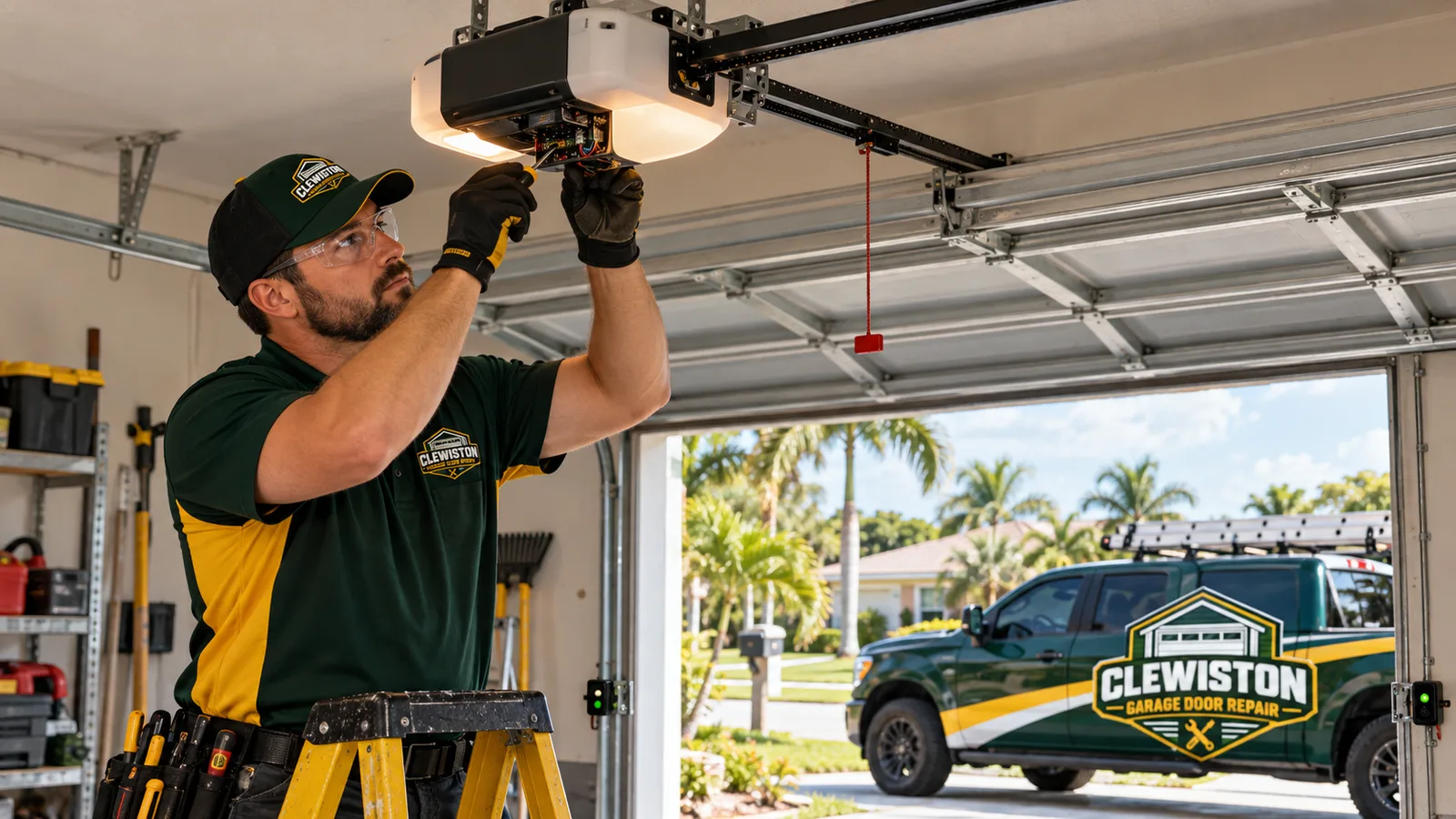
Separate opener faults from door faults
When the door will not respond, reverses unexpectedly, or makes a new grinding sound, the cause is not always obvious. Garage door opener repair in Clewiston, FL starts by separating an opener fault from a problem with the door itself. Clewiston Garage Door Repair can inspect the controls, power supply, travel settings, safety sensors, rail, trolley, drive assembly, and door movement before discussing the repair.
That distinction matters. An opener is designed to move a properly balanced door, not compensate for damaged hardware or excess resistance. If the door binds, feels unusually heavy when disconnected, or will not stay at a partly open position, the underlying door system may need attention. Broader garage door repair in Clewiston can address faults outside the opener's scope.
South Florida heat, humidity, wind-driven rain, and frequent thunderstorms can be hard on equipment near a garage opening. Moisture or dirt may interfere with low-mounted photo eyes, while power disturbances can affect controls or opener electronics. These conditions do not prove the cause, but they are useful clues during diagnosis.
Controls, sensors and drive systems
The inspection may cover the power source, outlet, motor unit, wall control wiring, lock mode, circuit board, and related connections. A remote with a weak battery is different from an opener that has no power.
If the wall control works but a remote or wireless keypad does not, the issue may involve batteries, programming, radio interference, or the control itself. Testing working and nonworking controls helps narrow the fault.
Misaligned photo eyes, blocked sensor lenses, damaged low-voltage wiring, incorrect force settings, or physical resistance in the door can interrupt closing. Safety devices should be tested rather than bypassed.
Grinding, rattling, and jerky movement may point to the rail, trolley, drive gear, chain, belt, or door hardware. The motor should not be adjusted to force a binding door through its travel.
A disconnected trolley, worn internal gear, failed drive component, or damaged attachment can leave the motor running without moving the door. The emergency release position is checked as part of diagnosis.
Intermittent operation can involve wiring, logic controls, settings, or power quality. Reproducing the symptom and testing components is more useful than replacing parts based on one brief failure.
Photo-eye troubleshooting
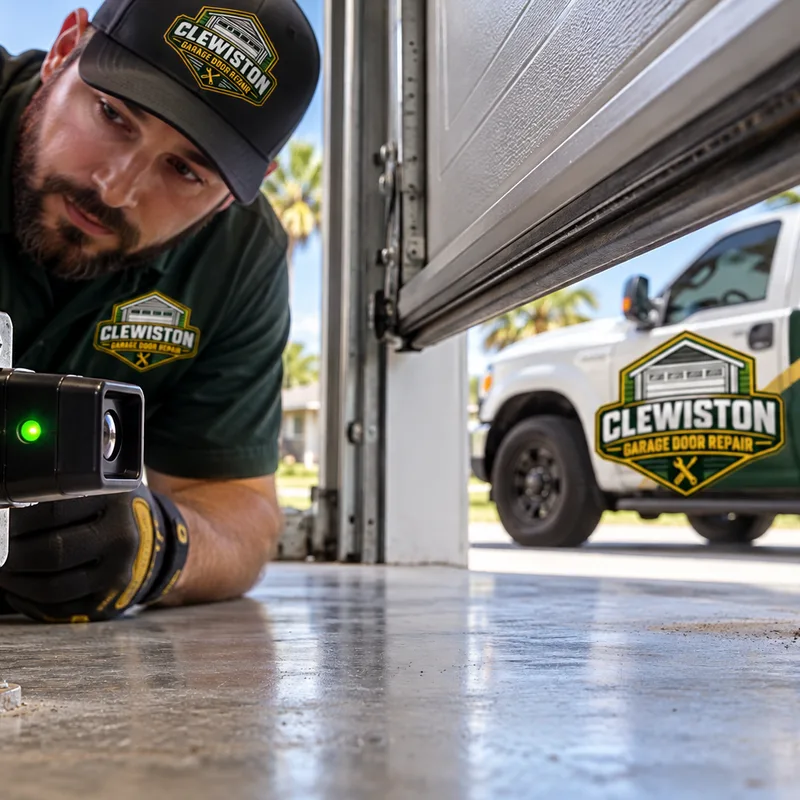
Modern automatic openers use a photoelectric safety system near the floor. The sending and receiving sensors must face each other across the opening. If the beam is blocked or the units are out of alignment, the opener may refuse to close the door or reverse it. Indicator lights can provide useful clues, but their exact behavior varies by manufacturer.
A careful check includes cleaning the lenses, confirming alignment, looking for loose brackets, and inspecting the thin sensor wires for cuts, pinches, corrosion, or poor terminals. Sunlight striking a sensor can sometimes contribute to intermittent behavior at a particular time of day. The test should also confirm that the door travels freely and that the opener's travel limits are appropriate.
Safety sensors are not an inconvenience to defeat. Holding a wall control or bypassing a sensor without finding the cause can allow the door to close when the opening is not clear. Clewiston Garage Door Repair can identify whether the fault is in sensor alignment, wiring, controls, settings, or another part of the system.
Four-step repair process
Step 1 of 3
The door is checked for binding, excess weight, track interference, and other mechanical resistance. The opener inspection then covers the power source, controls, sensors, rail, trolley, drive components, limits, and force behavior as applicable.
Step 2 of 3
Testing narrows the cause before repair choices are discussed. The finding may be a loose connection, sensor problem, incorrect setting, control fault, worn drive part, or an issue in the door system rather than the opener.
Step 3 of 3
After the agreed work, the opener is cycled through full opening and closing travel. Controls, reversal behavior, sensor response, and the emergency release are checked for proper operation.
Compare condition and compatibility
Repair often makes sense when the opener is otherwise in suitable condition and the failure is limited to a serviceable control, sensor, wiring connection, trolley, gear, or drive component. Replacement may deserve consideration when major parts are unavailable, several components are failing, or the rail or motor assembly has serious damage.
Compatibility matters. A replacement control board, remote, sensor, or wall station must match the opener's make and model requirements. Door size and weight, available headroom, power access, rail length, drive style, and current safety equipment also affect replacement requirements. A belt-drive unit may operate more quietly than many chain-drive models, but the right choice depends on the door and installation rather than drive style alone.
Do not keep running an opener that strains, stalls, or lifts a visibly crooked door. Repeated operation can add damage. Disconnecting the opener for manual use is appropriate only when the door can be moved safely and controlled by hand. A door that feels excessively heavy, drops, or binds should remain unused until inspected.
Arrange an inspection when the opener is unreliable, noisy, or unable to complete a full cycle. A clear diagnosis helps separate a minor control issue from a drive, electronics, sensor, or door-system fault.
CALL NOW: (863) 228-8333Troubleshooting and repair answers
Yes, many no-response faults are repairable, but the power source and door condition should be checked first. The cause may be an outlet or circuit issue, lock mode, damaged control wiring, a logic board fault, or a failed motor component. After South Florida thunderstorms or power disturbances, note when the failure began and whether the opener lights still respond.
A reversing door commonly indicates a blocked or misaligned photo eye, a wiring problem, incorrect travel or force behavior, or resistance in the door's movement. The lenses and indicator lights are useful starting points, but Clewiston Garage Door Repair also checks whether the door binds or reaches the floor before the opener expects it to.
Intermittent opener problems can often be diagnosed by comparing which controls fail and under what conditions. Loose wiring, radio interference, sensor alignment, heat-sensitive electronics, worn drive parts, or power interruptions may produce irregular symptoms. Recording the time, weather conditions, sounds, and diagnostic flashes can help reproduce the fault.
Manual use is reasonable only if the door is balanced, moves smoothly, and can be controlled safely. Pull the emergency release only when the door is fully closed whenever possible. Do not try to lift a door that feels extremely heavy, drops, jams, or sits crooked, because those symptoms can indicate a separate door-system problem.
Many opener faults can be diagnosed during one service visit, and straightforward repairs may be completed during that visit when the correct part is available. Timing depends on the model, fault, access, parts availability, and whether a separate mechanical issue is affecting the door. The inspection establishes the likely repair plan.
No, opener noise can come from the chain or belt, rail, trolley, mounting hardware, internal gears, rollers, hinges, or a door that is resisting movement. The type and location of the sound matter. Grinding from the motor housing suggests a different fault than rattling along the rail or popping at the door.
Reprogramming can fix a control that lost its pairing, but it will not correct a dead battery, incompatible remote, damaged keypad, receiver fault, or lock setting. Clewiston Garage Door Repair can compare the handheld remote, keypad, and wall station to determine whether the problem is limited to one control or shared by the opener.
Ready to troubleshoot the problem?
A focused inspection checks the opener, controls, sensors, and door movement to establish a clear repair plan.